"Globalizing Environmental Destruction: 'Free Trade,' the West and the Rest"
Timothy C. Weiskel
Director, Harvard Seminar on Environmental Values
Visiting Scholar, Institute of Liberal Arts and Interdisciplinary Studies, Emerson College
I. Introduction
The expansion of global trade and the liberalization of international trading regimes has involved a long and sadly repetitive history of ecological destruction. Writing nearly a half century ago, the great biologist, George Elton observed:
When contemplating the invasion of continents and islands and seas by plants and animals and their microscopic parasites, one's impression is of dislocation, unexpected consequences, and increase in the complexity of ecosystems already difficult enough to understand let alone control, and the piling up of new human difficulties.Anthropologists and ecological historians have underscored this fact and developed an understanding of the ways in which whole regions of the world have been subordinated to other regions as ecological units on the earth's surface
If we look far enough ahead, the eventual state of the biological world will become not more complex but simpler -- and poorer. (Charles S. Elson, The Ecology of Invasions, 1958)
It may not be improper to characterize as ecological imperialism the elaboration of a world organization that is centered in industrial societies and degrades the ecosystems of the agrarian societies it absorbs. Ecological imperialism is in some ways similar to economic imperialism. In both there is a flow of energy and material from the less organized system to the more organized one, and both may also be marked by the same euphemisms, among which "progress" and "development" are prominent.In this context, it is important, then, to emphasize that globalization is not new. Nor is the ecological devastation that inevitably accompanies it. Both processes have been linked in the development of human economies since the beginning of long-distance, trans-ethinic trade. Economic and ecological exchange have always out distanced the social units of community and jurisdictions of political control. Globalization involves the attempt to extend the realm of regulation and control to the range of ecological and economic exchange. This is always a "catch-up game," and it has never been fully achieved.
The anthropocentric trend I have described may have ethical implications, but the issue is ultimately not a matter of morality or even of Realpolitik. It is one of biological viability. (Roy Rappaport, 'The Flow of Energy in an Agricultural Society,' Scientific American (1971).
Nevertheless, in the modern era -- for the last 500 years or so -- there have been three overlapping, yet analytically distinct, phases in the driving force behind globalization. It is useful to keep these in mind, since each phase has a slightly different motivation behind it and consequently a different logic in to its historical development. To understand the nature of what has happened in the past and what is unfolding in our day, it is useful, then, to keep these three analytical stages clearly in mind. They are:
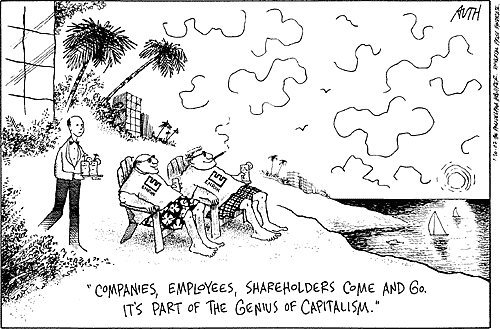
Each form of capitalism has its own "genius" -- that is, its own internal logic, it paradigmatic models of success, and its own forms of internal contradiction. Moreover, there are substantial contradictions between each major form of capitalism, and there are frequent are heated disputes between individuals and groups represented in each camp. Most recently, there have been marked disputes between financial capitalists and what might be called "managerial capitalists." The lines are often blurred between these two categories or classes of people, but many would argue that these internal contradictions are precisely the problem.
Dominant form of Economic Activity Type of Economic System Trade & Exchange
< 1450 - 1800(Merchants interested in "buying cheap and selling dear;" seek monopoly control of transportation; explore new sources of high value to weight ratio items and new markets to transport them to; merchants indifferent towards who produces goods)
Merchant Capitalism Fabrication & Manufacturing
1750 - 1929(The more "efficient" production of goods becomes key to "wealth;" requires access to "raw materials" and "free" labor, available for a wage; machinery, mechanical, water and carbon-based power increase total output which then must find outlets for sale.)
Industrial Capitalism Investment, Banking, Stock Exchanges
1603 - Present(Main source of wealth is interest on money that is loaned to merchants or industrialists; investments in joint stock companies afford differential returns, so stocks are bought and sold as if they were commodities; concern is for a maximum and continuous rate of return; little concern for where raw materials or labor comes from or how it is recruited or treated so long as the rate of return can outperform other sources of merchant or industrial capital; abstract measures of "welfare" -- Gross National Product & GNP per capita drive the calculations of public policy)
Financial Capitalism (Is this a "new" form of capitalism?) Managerial Capitalism?
II.
The Cold War and the Rhetoric of "Independence" and "Development"
Much of the interest in Third World areas increased after World War II as the world at large became enmeshed in a "Cold War" -- a prolonged standoff between "Eastern Block" countries -- consisting largely of the Soviet Union and its allies -- and "Western" countries made up largely of the United States and its Western European wartime allies.
Much of the Third World (India, Africa, and Asian countries) felt they had contributed substantially to the war effort or where made to suffer inordinately for what was essentially an intra-European struggle. The deterioration of economic, social and environmental circumstances during the war gave many an added impetus for opposing or resisting continued colonial oppression. The Europeans, for there part, were largely too weak to launch extended military campaigns in their colonies. In addition, they were "hoisted by their own petard" because of promises made to "liberate" people (largely Europeans) from "oppression." Roosevelt made this message a part of the "Atlantic Charter," and many emerging nationalist groups throughout the Third World looked to the U.S. as a beacon of hope in their anti-colonial struggles.
The U.S. for its part saw the danger of the "potential loss" of the former French and British colonies. With the Soviet Union emerging on the world stage as an alternative to the West, the U.S. feared that because of their bitterness toward their colonial masters, many of the anti-colonialist struggles would develop sympathies and explore potential economic relations with the Soviet Union and its Eastern European allies.
Such a move on the part of large numbers of Third World populations would have been interpreted by the corporations as a major tragedy. Their major concerns included the necessity of assuring access to raw materials, the need to seek out new markets for selling manufactured goods and the discover of new opportunities for investment. In short, the focus was upon the dominant interests of merchant, industrial and, increasingly, finance capital. The largest threat to the maintenance or expansion of financial capital was the threat that Soviets would gain inordinate influence in Third World regions and preclude or heavily restrict the terms of Western investment.
To counter this perceived threat, the U.S. and Europe because newly interested in the "development" of Africa, Asia and the Middle East. Since political emancipation was the preoccupation of the emerging nationalist elites in each of the areas of the Third World, both European regimes and the U.S. government became enthusiastic proponents (to varying degrees) of the "independence" of these states at the same time that it promoted "development" schemes to assure the continuity of access and dominance of control in local economies.
India led the way in 1948, and from 1957 onwards "independence" was granted to a remarkable number of regimes in an amazingly short period of time. At the same time Western financial interests recognized this transition to "newly independent" status as a truly staggering investment opportunity. Government "aid" packages were crafted accordingly, whereby the U.S. or former European colonial power would "lend" the newly independent Third World regimes vast sums of money to build roads, dams, railroads, refineries, power plants, ports, -- in short, all the infrastructure necessary for the next phase of merchant, industrial and financial capital to penetrate these regions of the world. This was largely "public money" (i.e.. from taxpayers) lent to Third World regimes which did one of two things with it: 1) purchased the goods and engineering services from the Western regimes from which the "loans" had come to build the infrastructure; and 2) pocketed a portion of the remaining amounts, placing the money in Western Banks and thereby returning it to its source.
In either case, ordinary populations saw little if any of the benefit of these funds, which circulated through these "newly independent countries" only to end up back in Western banks, bringing with them an incremental payment of interest. In some cases the loans were made on unrealistic economic terms to begin with, but the effort was fueled by an anti-Soviet anxiety. The thought was that even if the loan could not be repaid, perhaps the country's population would still look kindly upon America for the loan and support the U.S. in various international forums like the United Nations. In any case, the loans were thought to stimulate the development of the Gross National Product (GNP).
This is an overall statistical measure of the amount of economic activity, and it is true that vast amounts of money loaned to the Third World increased certain kinds of economic activity, event though it suppressed other kinds of activity. In effect, there was growth without development in most of the Third World regimes. That is, the overall measures of GNP and even GNP per capita often increased.
But this growth was taking place at
the expense of development. Incomes became more skewed to the very
few rich and the growing mass of poverty stricken populations, and the
countries involved had not changed the basic colonial structure of their
economies or polities. They were essentially agricultural economies
dependent upon commodity exports or extractive industries like mining or
oil exploitation. All the manufacturing still occurred in Europe
and what ever "independence" in political terms, it had no reality in everyday
life. "Neo-colonial elites" managed the system for the growing benefit
of foreign regimes and multinational corporations.
III.
"Trade Not Aid" -- Henry Kissinger
In many cases, the repayment of the loans was the very sincere intention of both the "donor" country and the "recipient country." But in the post-war era the international trading system worked systematically against the interests of the "primary producer." The reason for this is largely the triumph of the market ideology of trade integrated societies.
Whenever the bankruptcy of any particular regime became evident the Western world began to impose one "cookie cutter" solution. The effort was to restrict the release of further loans to these independent countries unless they agreed to certain conditions. This "conditionality" of loans from the World Bank made "independent," autonomous development virtually impossible. Development -- what ever that was supposed to mean -- had to take place increasingly according to the priorities of the World Bank and the International Monetary Fund (IMF).
Invariably these two institutions emerged as the dominant post-war economic mechanisms for enforcing the "export-led," commodity production model of growth in the Third World. Ironically, it the Bank and the IMF have ultimately "failed" because of their great success. The "secular decline" in commodity prices throughout the world, throughout the last 50 years makes this apparent to anyone who examines the "barter terms of trade." Basically the Third World regimes were caught in what was called the "primary producer's squeeze." The more they produce, the less they receive in return because gluts of commodities produce falling prices.
With the relative decline in income, and a need to maintain infrastructure and meet the needs for education, housing and health of a burgeoning population, Third World countries were induced to borrow money just to pay current accounts and keep the price of staple food-stuffs cheap in the capital cities. In asking for more money, however, the World Bank and IMF continued to impose "conditionality," and one after another of the Third World capital cities experiences "IMF Food Riots" as a result.
The only prescription
for this debt-sickness was more of the medicine that made the patient sick
in the first place -- expand commodity exports, cut government salaries
and social services, and keep your unruly populations in order with the
use or threatened use of violence. Thus the systematic exercise of
the international trading regime in the post-war world has lead to the
rise of violent and corrupt regimes committed to extracting surpluses from
an increasingly restive population that is told that it shouldn't be so
dissatisfied because the GNP is increasing.
IV.
International Struggle for "Free Trade"
As inequitable and unjust as the "business as usual" scheme of post-war international trade has been, there are still those who seek to pass agreements and regulations to make it work even more in their particular interest. Specifically, the international business community -- primarily led by the transnational corporations -- as sought support from a whole range of governments to further its capacity to trade more freely, control the conditions of manufacturing and open up unrestrained opportunities for investment.
To this end, merchant, industrial and financial capital has sought to influence governments around the world pass a series of "free trade" agreements to facilitate their welfare. The North American Free Trade Act (NAFTA), the General Agreement on Tariffs and Trade (GATT) and its successor the World Trade Organization (WTO), the Multilateral Agreement on Investments (MAI), and the forthcoming Free Trade Agreement for the Americas (FTAA) are all designed to accomplish this. Citizens -- or for that matter their legislators -- have not always been well informed about the provisions and mechanisms of these agreements. Nevertheless, once they are passed, these "free trade" agreements have enormous implications both within the industrial world and in the Third World.
It is for this reason that numerous groups have begun to react angrily to two aspects of these corporate crafted agreements. (See: "What Happened in Seattle?") First, there is a growing concern and vocal concern for the way in which these agreements will affect social, labor and environmental standards in this country and across the world. Secondly, there is a smoldering anger, bordering on explosive outrage, at the ways in which these "sweetheart deals" for investors were railroaded through the reputedly "democratic" institutions in virtually every country of the world.
VI. Where Can We Go From Here?
- Learn What is Happening around you
- View From Abroad: A Yawn, a Grumble, and After All It's Just Not Europe, Is It?
- The Buzz: World Economic Forum Plays Down the Scandal
- Protests: 150 Arrests Far From Economic Forum
- Party: Hot Dogs and Foie Gras, but No Relish
- Notebook: One Hand Upholding the Law
- Finding Gems of Genius Among Enron's Crumbs
- The Police: A Second Day of Waiting, and Still No Major Protests
- Protests: 36 Are Arrested, but Demonstrations Remain Peaceful
- Demonstrators: Simple, if Radical Agendas Lead Thousands to Protest
- Security: Police Keep Close Eye on Protesters, but Let Them Have Their Say
- Diary: Is it Worth Bending to Pick Up Just $100?
- Party: One Determined Couple and a Few Extra Guests
- 2 Top Officials Offer Stern Talk on U.S. Policy
- Workshops: Where McDonald's Sits Down With Arab Nationalists
- Diary: Art's Message to World: Simply, Eat the Riches
- The Streets: Now Showing Daily: Well-Rehearsed Play of Discontent
- The Parties: Protecting the Food Supply for Some High-Powered Meals at the Waldorf
- The Protest: To Some, Marching Is Old Hat, Even if the Issues Are Not
- The Meeting: Economic Forum Draws Rich, Powerful and 'Spoiled'
- Workers: Labor Brings Witnesses to Tell of a Harsher Side to Growth
- Billionaire? Supermodel? You're Not Invited
- Video: World Economic Forum on Saturday
- Video: Protests on Saturday
- Audio: Serge Schmemann, The Times's U.N. Bureau Chief
- Video: Protesters in Manhattan on Thursday
- Learn what is happening abroad
- Start to document what is happening and talk about the issues with friends and fellow students: -- Specifically, organize something for the forthcoming film:
- AND join the forthcoming "House Parties" for viewing the Bill Moyers, Special Report: "Trading Democracy" on Thursday, 21 February at 8:00pm.
- Consider the Reporting on the Davos NYC (WEF) meetings
vs. the Porto Alegre (WSF) meetings

- Annan
Cautions Business as World Forum Ends
By SERGE SCHMEMANN
The United Nations chief closed the World Economic Forum by telling business leaders that "business cannot afford to be seen as the problem."
THE POLICE
Shrewd
Anticipation Helped Avert Trouble
By
WILLIAM K. RASHBAUM and AL BAKER
Thoughtful
preparation by the New York City Police Department before the World Economic
Forum even began, helped keep the peace by keeping protesters off balance.
Final
Item on Agenda: Slow Down
By
JIM DWYER
As the
certified masters of the universe prepared to roll out of town at the conclusion
of the World Economic Forum yesterday (exact motto: "Committed to Improving
the State of the World"), many of them finally got down to business.
 Instead
of Dessert, It Was Clinton at Waldorf
Instead
of Dessert, It Was Clinton at Waldorf
By
TODD S. PURDUM and DAVID E. SANGER
Some
300 world leaders were held spellbound on Sunday night by former President
Bill Clinton, the ultimate Davos Man.
THE STREETS
So
Long New York, and Thanks for a Mostly Well-Ordered Bash
By
DAN BARRY
In the
end, the World Economic Forum went off so smoothly that — aside from some
minor traffic inconveniences — the lives of most New Yorkers were unaffected.
• Shrewd
Anticipation Helped Avert Trouble
• Protesters
Leave Pleased, but Also Frustrated
THE PROTESTERS
Mostly
Pleased, but Knowing Few Heard Their Message
By
ANDREW JACOBS
As the
last of the rallies petered out on Monday, the demonstrators who came to
New York to rail against the World Economic Forum expressed vindication
and frustration.
Multimedia
Links:
• World
Economic Forum Home Page
• Video:
Schedule of Forum Sessions Available via Webcast
A GLOBALIZATION READER
Selected Articles from The Times
• The
West's Loosening Grip (Dec. 17, 2001)
• Arbiters
of Global Rights and Wrongs (June 21, 2001)
• Anarchists
and Capitalism's Rise (Aug. 8, 2000)
• Seattle:
Free Speech vs. Free Trade (Dec. 5, 1999)
• Global
Trade: Conflict and Hope (Nov. 28, 1999)
Protest Sites
A selection
• New
York City Central Labor Council
• Public
Citizen
• International
A.N.S.W.E.R.
• Students
for Global Justice
• Public
Eye on Davos
• Jobs
With Justice
• Another
World Is Possible
• Anti-Capitalist
Convergence
- BBC Reporting:
Alternative
forum tries to define agenda
Saturday, 2 February, 2002, 15:42 GMT
By the BBC's Ian Bruce in Porto Alegre, Brazil
Discussions are under way at the World Social Forum
- a gathering of anti-globalisation groups in Porto Alegre, southern Brazil
- to try to develop an alternative to the policies being discussed at the
World Economic Forum in New York.
The 26,000 delegates - and many more observers from
around the world - are to spend three days debating controls on international
money markets, the scrapping of the World Trade Organisation, and new forms
of participatory democracy.
It's the anti-globalisation movement's first big
gathering since the 11 September attacks in the United States.
Delegates are also keen to voice their opposition
to Washington's war on terror.
02 Feb 02 | Business
New York prepares for protests01 Feb 02 | Americas
Forum protesters look to ending war
Tuesday, 5 February, 2002, 16:56 GMT
Was this still really Davos?
Or was it just another major international conference graced by big corporate and political names, this time hosted in one of New York's most renowned hotels within a stern cordon of 3,800 NYPD cops?
As the 3,000 delegates and spouses packed their corporate gifts, exchanged their last business cards and checked out, there was no consensus.
Many for whom Davos could only be Davos just did not want to countenance the idea that the Waldorf Astoria in mid-town Manhattan was an appropriate alternative - even to show solidarity with New York after the 11 September terrorist attacks.
Friday, 1 February, 2002, 15:28 GMT
 The BBC's Tom Gibb
"September 11th has.. made it harder to protest"
Chilean author and academic, Ariel Dorfman
"They can no longer be seen to be attacking the same things as those behind terrorist attacks"
American intellectual, Professor Noam Chomsky
"The World Economic Forum are the clear opponents of world capitalism"
By the BBC's Tom Gibb in Porto Alegre
While the world's economic leaders meet in New York, their opponents kicked off their own rival conference in the southern Brazilian city of Porto Alegre with a display of music, dance and slogans against US military actions and capitalist globalisation.
The World Social Forum - first held in the city last year - grew out of the mass protests and street battles with police in cities such as Seattle and Prague.

An important film festival related to themes of this course is now screening in three different locations in Boston.It is the Human Rights Watch International Film Festival.
Check the schedule of the Festival by clicking on the poster picture, and if you can possibly arrange to see any of the films, please do. In particular the film, Life and Debt deals directly with subjects that we will be exploring later in term.
Check schedules by clicking on the Festival poster image (to the right. ==>)
To listen to a discussion of the films check out:
Human Rights Watch - International Film Festival, 2002
WBUR, Special Report, January 25, 2002
Listen particularly to this excerpt about
the character of documentary human rights film, and this exerpt
about the film: Life and Debt dealing with circumstances
in Jamaica. Life
and Debt will be screened at 7:30 on Sunday at the Coolidge
Corner Theater. (Check out the film
description).
Other films in the Festival include ones from Palestine,
Rwanda and Afghanistan. When Alberto Vendemmiati and Fabrizio Lazzaretti
began shooting their film "Jung (War): In The Land Of the Mujaheddin,"
the civil war in Afghanistan was far from most Americans' radar screens.
Now that "Northern Alliance" and "Taliban" have become household words,
the stark and heart-rendering film has taken on a new significance. "Jung"
is one of 18 films from 12 countries that will be featured in Human Rights
Watch's International Film Festival, taking place this weekend in Boston.
According to organizers, all of the films "provide
a human face and personal testimony to threats against political and individual
freedom." This hour, we preview the festival and discuss the role that
art can play in the struggle for human rights.
Guests:
Bruni Burres, Director of the Human Rights Watch
International Film Festival
Fred Wiseman, Director of over 30 films about social
issues; his "Titicut Follies" is the only work to have restrictions place
on it by a U.S. court for reasons other than obscenity or national security.
For those of you unable to see the film in this weekend's Human Rights Film Festival, it will be screened on for a week from Friday, 22 February through Thursday, 28 February at the Brattle Cinema in Harvard Square. We can discuss in class how we all might make arrangements to see the film individually or as a group.
 Maude Barlow, on the MAI (Multilateral Agreement on Investments). The
MAI will go far beyond NAFTA in allowing transnational corporations to
vie for control of our health care and education systems, telecommunications
and cultural industries, public utilities and municipal services and more--so
what is it? Produced by Working TV.
Maude Barlow, on the MAI (Multilateral Agreement on Investments). The
MAI will go far beyond NAFTA in allowing transnational corporations to
vie for control of our health care and education systems, telecommunications
and cultural industries, public utilities and municipal services and more--so
what is it? Produced by Working TV.
Because it was interrupted in class, you can view the video clip on a hi-speed internet connection through a RealPlayer - click here to view:
Global Village - Global Pillage