 Lecture Video
 Class Research Resources and Assignments
Lecture Video Private
Lands - Public Problems
(Click pictures
for access to articles)
|
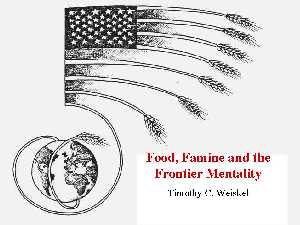
"Viewed globally, the world's agricultural ecosystems on which all of us depend are evolving in directions and at rates we perceive only dimly at present. Our survival -- not merely as a nation-state, but as a species -- rests upon our awareness of the transformations in global agroecology and upon our capacity to mitigate their most destructive effects....it remains an open question whether a global ecosystem can sustain the food production strategies that are presently practiced or currently proposed." |
||||||||
|
T. C. Weiskel, "Food, Famine and the Frontier Mentality," (1981). |
||||||||
|
One of the most extensive uses of privately held land in America and throughout
the wider world is that involving agriculture. An examination of
the use of these lands reveals that private land management decisions
often lead to the generation or exacerbation of public problems. We need
to ask ourselves: How have agricultural lands been managed in the past?
What are the factors that lead farmers
to manage their lands poorly? The international cash-crop/food-stuff trade has emerged as a global pattern of ecosystem organization as a legacy of the colonial domination of some peoples of the world by others. Colonialism as a political system has collapsed, but, for the most part, this fact has not halted the emerging trends in agricultural land use established under colonial rule.
Since formal systems of colonialism have collapsed, the logic of agricultural
production has come to be dominated by large multinational food and commodity
corporations.
Managers of these firms and In the recent evolution of agricultural systems concepts of "ownership" have been extended from land to the crops themselves -- and more particularly to the genetic material that they "express." Genetic materials of the world's major cultigens are being collected and stored in "gene banks" -- both private and public. Agribusiness corporations and many governments argue that this is necessary to assure the world's future food supplies. Others in the Third World regard the "privatization" of global plant genetic material as a form of "biopiracy" and fear that this form of private control over public resources is both socially unjust and ecologically destructive. Local land management decisions around the world in the agricultural sector are in many cases made in reference to these larger global market considerations. All decisions in this realm have imbedded ethical implications. |
||||||||
|
Related Bibliography:
|
||||||||
|
Post-Lecture Supplementary Materials |
|
|
Please listen to this week's "One Planet" from the BBC: (this program will only be available until the 7th of November, since it is a weekly program that gets changed as soon as the new one becomes available.
This program is a report on the issue of who owns the seeds in the global agricultural system, and it follows and develops many of the themes raised in the latter part of the lecture on 29 October (see above link). |
|
|
In
addition, when you have the time, you should link to the full length lectures
(text and audio and video, in some cases) for the |
|
|
Finally, you may find helpful for further discussion of these matters some of the materials that were assembled here at Harvard in the Spring of 2000. On 28 April 2000, the Working Group on Environmental Justice here at Harvard co-sponsored a public debate: "The Genetic Revolution and Its Role in Developing Countries." For that debate, the Working Group assembled a number of resources which can be found on the web page devoted to: "Biotechnology and Environmental Justice." The material on this page is somewhat dated, and some of the links it provides to news stories are not longer valid. Nevertheless, there is useful material on the page for anyone wishing to pursue research on biotechnology and agriculture in the Third World. |
|

 One Planet - The World's Seeds.